
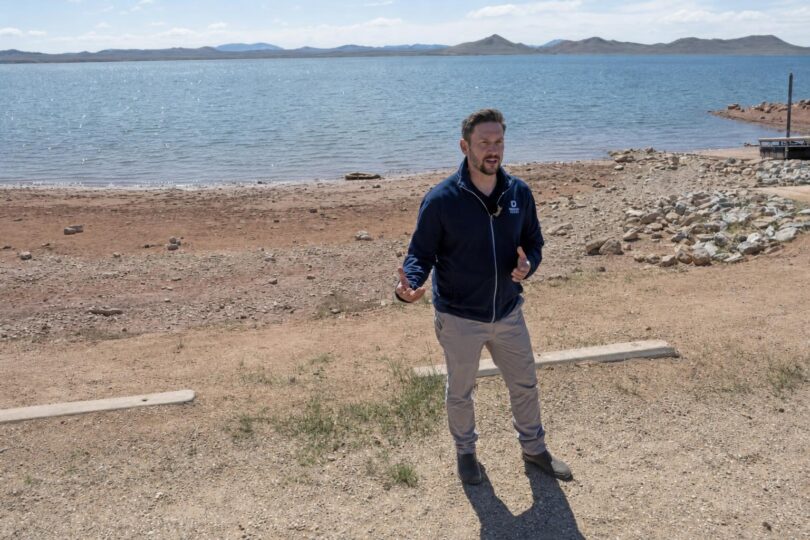

The Denver Gazette reports that Gov. Jared Polis has declared a statewide drought emergency after record-low snowpack, warm temperatures, and drought conditions across all 64 Colorado counties.
This is not a “Polis piece.” This is a water piece. For Weld County, drought is not a press conference problem. It is a ditch problem, a pasture problem, a fire risk problem, a municipal planning problem, and a kitchen-table budget problem.
The article says Colorado’s snowpack peaked around 58% of normal, melted early, and left dry soils ready to soak up runoff before it reaches streams and reservoirs. That may well justify a drought declaration. But now comes the part that matters: what authority is being activated, what help is actually coming, who sets priorities, and whether counties are treated like partners or props.
The Bullet Point Brief
- Polis declared a statewide drought emergency and moved Colorado into Phase 3 of the state drought response plan. Translation: the state just pulled the bigger lever, so now taxpayers deserve to see what that lever actually does.
- The article reports all 64 counties are abnormally dry, with nearly 93% of Colorado in moderate to exceptional drought. That is not “save the planet” brochure language. That is “protect the farm, the ranch, the hydrant, and the paycheck” language.
- Snowpack peaked at about 58% of normal and melted early after a warm March. Dry soil is expected to drink up runoff before it reaches streams and reservoirs. A press release does not put water in a ditch.
- Reservoir stress is already real. Denver Water began draining Antero Reservoir to save water from evaporation. That is the kind of practical math water managers deal with while everyone else is busy naming committees.
- Phase 3 can mean major crop or pasture loss, more water restrictions, and reservoir shortages. That means agriculture, small towns, energy operations, fire protection, and household costs all need clear answers, not vague emergency fog.
My Bottom Line
Drought response should protect people, property, agriculture, and water rights while keeping government in its lane. That means coordination, not command-and-control theater. It means fast information, measurable help, and respect for the local people who actually know their water systems.
In Weld County, water is not an abstraction. It grows crops, waters livestock, supports energy production, keeps small towns functioning, and helps families manage costs that already feel like they were designed by a committee of raccoons in a grocery store. When water gets tight, paychecks get tight. Farm margins get tight. Fire risk gets serious. That is where government should be useful, focused, and humble.
The state needs to show its receipts. What specific authority does Phase 3 activate? What resources are coming to counties? Who decides priorities? How are senior water rights protected? How are producers supported before the damage is done? How are local water managers included before decisions roll downhill from Denver?
Stewardship matters. So does liberty. Colorado can take drought seriously without turning it into apocalypse theater or a permission slip for top-down mandates. Protect senior water rights. Trust local control. Communicate quickly with counties. Help producers. Keep the criteria public. Measure results in acre-feet, response times, costs, and real relief.
Water policy is not about slogans. It is about whether the next family farm survives, whether the next wildfire is contained, whether the next small town has a workable plan, and whether the next worker still has a job. We’ll measure this in months and dollars, not slogans.
Source: The Denver Gazette
