

The Colorado Sun reports that federal water managers are backing away from the 20- to 30-year Colorado River deal many officials wanted and are instead floating a 10-year framework, with reservoir operations revisited every two years.
The piece centers on frustration from water officials gathered in Boulder, where negotiators are trying to plan for the future of a river system that supports 40 million people. The current rules, set in 2007, expire this fall. The seven Colorado River states have not reached a unified agreement, which means the federal government is preparing to decide what happens next.
Here’s what matters for Weld families: water uncertainty does not stay neatly parked on the Western Slope or in a federal meeting room. It reaches farms, food prices, housing, energy, recreation, fire risk, and the tax base that keeps local services running. A 30-year problem does not become solved because Washington found a shorter calendar.
The Bullet Point Brief
- Federal water managers wanted a 20- or 30-year deal, but now they are talking about a 10-year framework. That is not exactly the long-range certainty farmers, cities, water providers, or counties were hoping to hang their hats on.
- The proposal would tie operations at Lake Mead and Lake Powell more closely to real-time conditions. That part makes sense. Water policy should notice whether there is actual water in the bucket.
- The problem is the every-two-years renegotiation cycle. Colorado’s top river negotiator, Becky Mitchell, warned that constant renegotiation would make it harder to create the certainty 40 million people deserve. She’s right. You cannot plan a farm, a subdivision, a water treatment plant, or an energy operation on “check back after the next election.”
- Andy Mueller of the Colorado River Water Conservation District called the structure disappointing and said river negotiations need to be less political, not more political. That is the sound of a grown-up noticing that water math and campaign calendars make terrible roommates.
- Tribal and Lower Basin officials also raised concerns, including who bears reductions, whether damage is offset, and whether the plan changes how water laws work in practice. When multiple sides are saying “show us the details,” that is not obstruction. That is responsible government.
My Bottom Line
Colorado needs durable, enforceable water certainty, not another federal Band-Aid with a nice binder clip on it. A short-term plan may keep the lights on in negotiations, but it does not give counties, producers, cities, water providers, or industry the planning horizon they need.
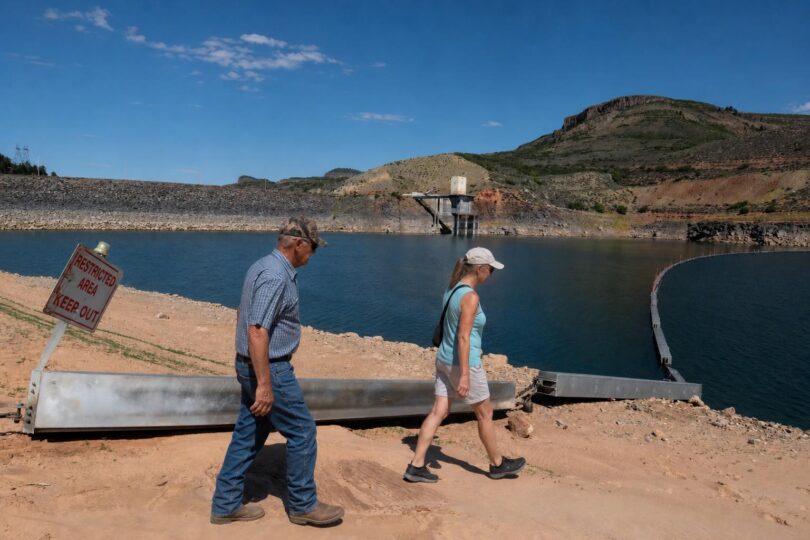
I’m not interested in villain-hunting here. Drought is real. Reservoirs are stressed. The Blue Mesa photo alone tells a story nobody needs to exaggerate. But theatrical doom does not grow hay, fill a stock tank, protect a senior water right, or help a small town water manager explain next year’s rates to residents.
Colorado must defend its compact rights and insist on fairness across the basin. Stewardship is not surrender. Conservation cannot mean rural Colorado always takes the haircut while everyone else gets a planning memo and a pat on the head. Property rights, prior appropriation, and local control have to mean something when the pressure is on, not just when the reservoirs look pretty.
The next step is verification and accountability. What exactly does the federal proposal require? Who takes reductions? How are impacts measured? What happens to agriculture, municipal planning, hydropower, recreation, and future growth? When does the public get clear answers instead of another round of water-speak from people who could make a rain gauge sound like a legal deposition?
Weld County families, farms, jobs, and water future need a real deal, not another punt. We’ll measure this in acre-feet, timelines, local impacts, and enforceable commitments, not slogans.
Source: The Colorado Sun
