
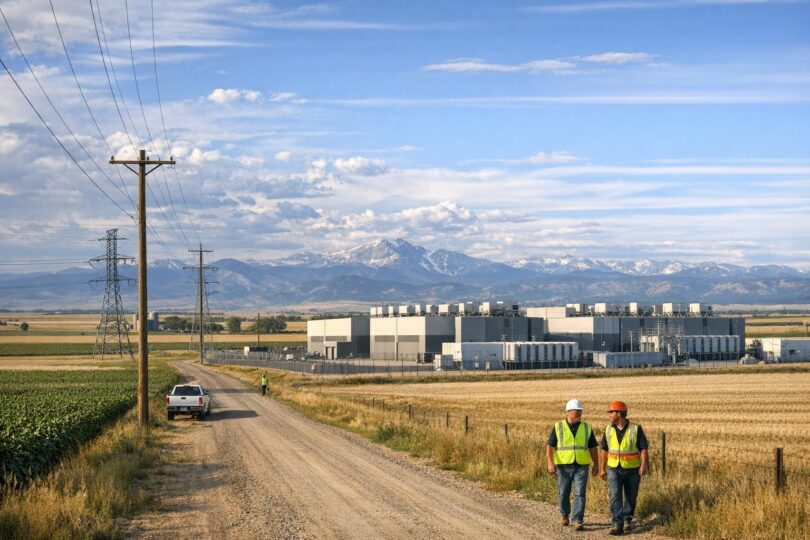

I have been hearing from a lot of people about AI data centers, and I understand why. When folks hear the words data center, they do not just think about computers. They think about water. They think about power. They think about traffic, noise, land use, and whether a project like that fits the place they call home.
Those are fair questions. In fact, they are exactly the kind of questions local government ought to be asking.
I think the best way to handle this conversation is pretty simple: facts need to beat fear. But facts also need to beat corporate spin. Weld County should not make decisions because people are panicked, and we should not make decisions because somebody shows up with a polished sales pitch and a stack of promises. Our job is to sort through the noise, get to the facts, and write code that protects the people who already live here.
The first fact is that data centers are not a temporary trend. They are a real part of the modern economy, and that is only becoming more true as artificial intelligence grows. The U.S. Department of Energy, drawing on work from Lawrence Berkeley National Laboratory, reported that data centers used about 4.4 percent of all U.S. electricity in 2023 and could rise to roughly 6.7 to 12 percent by 2028. That same federal report found data-center electricity use climbed from 58 terawatt-hours in 2014 to 176 terawatt-hours in 2023. In plain English, this is not some niche industry waiting to fade away. It is a major and growing infrastructure issue. (LBNL)
So yes, Weld County needs to be ready for this. But being ready does not mean waving everything through. It also does not mean assuming every proposal is a disaster before anybody has read the fine print. Our responsibility is to stay levelheaded and do the work. That means writing smart code, setting clear standards, and making sure any project fits Weld County instead of asking Weld County to bend around it.
What local government needs to nail down
- Water standards should come first, because ongoing evaporative loss is a real local concern.
- Closed-loop cooling should be the baseline, with clear definitions and proof from applicants.
- Power infrastructure must be adequate so existing residents and businesses are not pushed aside.
- Noise, roads, buffering, and project scale need to be addressed up front in county code.
- Weld County should review facts carefully and not govern by panic or polished brochures.
That starts with water.
Around here, water is not just another line item in a technical report. It matters to families, farms, businesses, and the long-term health of the county. That is why residents are right to focus on it. The Environmental Protection Agency explains that cooling towers lose water primarily through evaporation, and also through blowdown, which is water discharged to manage mineral buildup in the system. In other words, some cooling methods are built around ongoing water loss as part of normal operation. (US EPA)
That is why I believe Weld County should take a firm position here. We should not allow evaporative-cooled data centers. If a company wants to build one of these facilities in Weld County, it should be required to use closed-loop cooling, not a system that depends on continual evaporative water loss.
That is not a made-up standard. Closed-loop systems are real, established technology. NREL has described its own high-performance computing facility as using an energy recovery water loop that is a closed-loop system, and its materials explain how that system captures and manages heat without relying on the same kind of open evaporative loss associated with conventional cooling towers. (NREL)
Now, that does not mean every project that says closed-loop should automatically get a gold star. Words on a brochure are not enough. County code has to define the standard clearly, and applicants need to prove they can meet it. If a project cannot show, in real terms, how it will operate without putting new strain on local water resources, that project should not move forward. That is just common sense.
Power is the next big issue, and it is every bit as important.
Data centers can be very large electric loads, especially as AI computing expands. NERC, the organization responsible for assessing bulk power system reliability across North America, has warned that rising demand from data centers and other large loads is intensifying reliability concerns. Its 2025 Long-Term Reliability Assessment says uncertainty and lag in new resource additions are creating concern that parts of the system may struggle to keep up with growing electricity demand, including from new data centers. (NERC)
That matters here. Weld County should be crystal clear that any proposed data center must have adequate power infrastructure to operate without negatively affecting the people and businesses already here. Existing residents should not be put at risk of higher strain on local systems because somebody wants to bring in a massive new load before the infrastructure is ready. Farms, homes, small businesses, and existing industry all matter. They are not second in line.
And then there is the part people sometimes treat like an afterthought, even though it is very much not an afterthought: quality of life.
Noise matters. Road impacts matter. The look and scale of a project matter. Compatibility with nearby land uses matters. If a facility is proposed in the wrong place, or if it is poorly buffered, poorly designed, or poorly reviewed, that affects real people in real neighborhoods. Those concerns are legitimate, and they belong in the county’s code and review standards. They should be addressed up front, not brushed aside after the fact. Brookings has noted that data center growth can create major local land-use and infrastructure questions, which is exactly why local governments need clear standards instead of vague promises. (DOE)
That is the balance I believe Weld County needs to keep. We do not need to pretend data centers are harmless. We also do not need to pretend they are automatically bad. We need to be grown-ups about it. These facilities are part of the modern economy. They are not going away. But that does not give any company a free pass to use Weld County’s water, power, roads, and land without serious scrutiny.
My view is straightforward. Weld County’s job is not to blindly approve projects, and it is not to govern by rumor. Our job is to protect this community with clear rules, careful review, and a little backbone. Facts should beat fear. Facts should also beat corporate spin. And if we do our job right, we can write code that recognizes economic reality while still putting Weld County residents first.
That is what prudent local government looks like. It stays calm, asks hard questions, and keeps the community protected.
Weld County will host two Town Halls to discuss the Data Center code and hear from our citizens. The first Town Hall meeting is Monday, March 23, 2026, in the Events Center at the Weld County Administration Building, 1150 O Street in Greeley. The Town Hall will be from 6:00 p.m. – 7:30 p.m. The second Town Hall will be on Tuesday, March 24, 2026, in the Large Conference Room of the Weld County Southwest Service Center Complex, 4209 County Road 24 1/2 in Longmont (Firestone) from 6:00 p.m. – 7:30 p.m
