

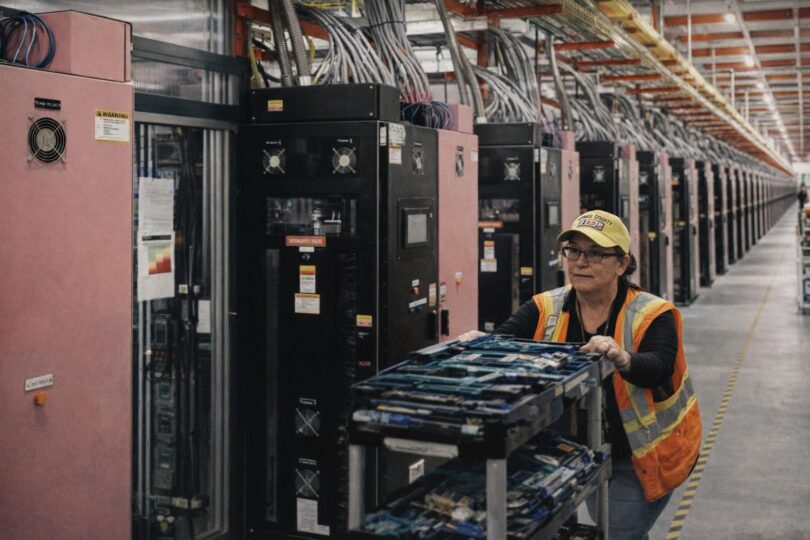

This piece in The Greeley Tribune, picked up from Tribune News Service and originally reported by Bryce Gray of the St. Louis Post-Dispatch, is one of those articles that checks every national-story box and somehow still manages to say almost nothing concrete about the place where readers actually live. It runs through the now-familiar concerns about data centers and water use, noting that facilities can consume substantial amounts of water depending on size, cooling method, and climate, and that rural communities are especially nervous when wells, aquifers, and small local systems are part of the picture.
The article raises fair questions. It notes that medium-sized facilities may use around 1 million gallons on peak days, larger ones could use far more, and experts say transparency is often lacking when companies or local governments talk about projected demand, sourcing, and impact on utility systems. It also points out that some projects promise air cooling most of the year, closed-loop systems, recycled water, or developer-funded upgrades, while critics still worry that the details are too vague to evaluate honestly. That part is real. The vagueness is not a bug in this article. It is basically the whole article.
And that is exactly why this matters locally. The Tribune ran a generic national piece because it had the magic words “data centers” in it, and people are going to read it looking for clarity on a question that deserves local clarity. In Weld County, this is not academic. We recently wrote data centers into our code. I was the lone no vote, not because I oppose data centers, but because I wanted tighter guard rails around water usage before we opened the door wider. I do believe data centers are critical infrastructure for the new economy, just like roads, water, sewer, and electric are critical infrastructure for the economy we already have. But critical does not mean careless.
The Bullet Point Brief
- The article says data centers can use a lot of water, especially on peak days, and that local impact depends on size, cooling system, and climate. Fair enough. That is true, broad, and about as sharp as a butter knife.
- It notes that rural residents are often especially concerned because many rely on wells and smaller water systems. That is the part people around here will rightly zero in on, because “trust us” is not a water plan.
- The story walks through air cooling, evaporative cooling, and closed-loop systems, plus claims from companies that they can minimize water use or offset costs. Translation: there are options, but the devil is in the details, and the details are usually hiding behind the curtain.
- The strongest part of the article is actually its point about transparency. Experts quoted in the piece say data centers suffer from major public data blind spots and that many proposals are so vague it is hard to know true water requirements, sources, or withdrawal rates. Now we are getting somewhere.
- What the article does not do is answer the question local readers actually have: what does this mean here, on our ground, with our water, our code, and our farmers? So readers get a national shrug wrapped in a headline.
My Bottom Line
I am not anti-data center. Let me say that plainly. I think data centers are critical infrastructure to the new economy the same way roads, water, sewer, and electric are critical to the present-day economy. If we want to compete, attract investment, and build for the future, we cannot pretend this sector does not matter. It does.
My no vote in Weld County was not about rejecting that future. It was about insisting that if we are going to welcome that future, we do it with our eyes open and our priorities straight. I wanted tighter guard rails around water usage. I did not want the farmer down the road competing with Meta or Microsoft when it comes time to secure water. That is not anti-growth. That is called having a little sense.
Here’s what matters for Weld families. Water is not an abstract policy toy out here. It is life, food, property value, business continuity, and plain old common sense. If a proposed facility is enormous, then its water profile matters. If it is going into the wrong zone, that matters too. If the rules are vague, then the public is right to be skeptical. You can only stack so much wishful thinking before it topples like hay bales in a windstorm.
I do believe we can coexist with data centers. I believe that firmly. But coexistence requires intention. It requires clearer standards on water, smarter limits tied to project size, and a harder look at where these facilities belong and where they do not. The rest of the board did not see it my way on the first pass. Fine. I am still going to keep working on it.
Because the right answer is not blind opposition, and it is not blind approval either. The right answer is responsible growth with real guard rails, real transparency, and real respect for the people already here. That is how you protect the next economy without selling out the one that feeds us.
Source: The Greeley Tribune
