
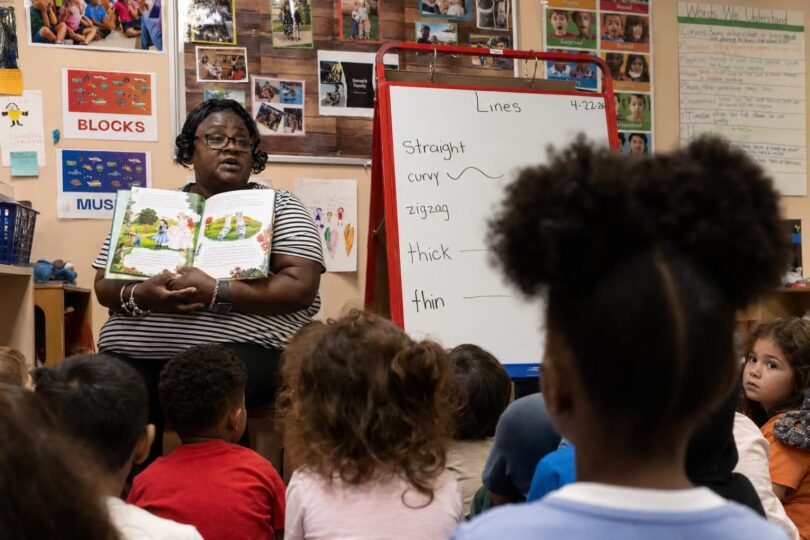

The Associated Press story, published by The Denver Post and written by Moriah Balingit, reports that state-funded preschool enrollment hit a record high last school year. Nationwide, 1.8 million children were enrolled, reaching 37% of 4-year-olds and about 10% of 3-year-olds, with states spending an unprecedented $14.4 billion on these programs.
Colorado is presented as one of the big movers. The state launched universal preschool in 2023 and now ranks third nationally for access among 4-year-olds, with about 70% enrolled. That sounds impressive, and for many families it is real help. But the same report says Colorado met only two of 10 preschool “quality standard benchmarks.” So yes, the bus is full. The question is whether anyone checked the brakes.
The Bullet Point Brief
- Colorado is now near the top of the national preschool-access scoreboard, with about 70% of 4-year-olds enrolled. That is a big number, and in politics, big numbers tend to attract press releases like flies to a county fair funnel cake stand.
- The state offers most 4-year-olds up to 15 hours of free preschool each week, with some children qualifying for 30 hours. Free is a powerful word, but taxpayers know the truth. “Free” usually means the invoice took the scenic route.
- The report says Colorado met only two of 10 quality benchmarks. That is the part where the parade float hits a pothole. Access matters, but a seat in a classroom is not the same thing as a high-quality education.
- The article points out a real tradeoff: when states scale up fast, quality can lag. Government is very good at building a program, naming it something friendly, cutting a ribbon, and then promising to fix the details later.
- The story celebrates more kids in preschool, and that is not nothing. But it leaves big questions hanging: What happens to private providers? What happens to younger and older kids who still need child care? Are faith-based preschools treated fairly? And how much more government dependency are we comfortable building before breakfast?
My Bottom Line
I am glad more kids are getting a strong start. I mean that. A good preschool can help a child walk into kindergarten with confidence, structure, and a better shot at success. Families are under pressure, child care is expensive, and working parents are trying to make the math work with grocery prices that look like they were written by NASA.
But let’s not confuse good intentions with good policy. Colorado can brag about access, but if the state only hits two out of 10 quality benchmarks, that is not a victory lap. That is a yellow warning light. Government should not get to say, “Look how many seats we filled,” while taxpayers and parents are left asking whether those seats are delivering what was promised.
Here’s what matters for Colorado families: preschool policy should support parents, not replace them. It should strengthen child care choices, not quietly kneecap private providers. It should help families with 4-year-olds without ignoring the 2-year-old, the infant, or the school-age child who still needs care when mom and dad are working. A one-size-fits-all program may look tidy on a state spreadsheet, but families do not live on spreadsheets.
I also want a straight answer on whether faith-based preschools are getting a fair shot. Freedom of religion does not mean government gets to smile politely at churches while steering public dollars elsewhere. If parents want a religious preschool that meets health, safety, and education standards, the state should not treat that choice like a skunk at the garden party.
So yes, I’ll give credit where it’s due. More access can be good news. But access without quality, choice, fairness, and fiscal honesty is just bureaucracy wearing a backpack. We should measure this in outcomes, dollars, and parental choice, not slogans.
Source: The Denver Post
