

Bill Summary
SB26-033 creates a new Colorado Clean Energy Permitting Coordination Office inside the Colorado Energy Office to coordinate permitting for “covered clean energy projects.” It also adds new required planning documents and public posting requirements tied to permitting timelines.
- Creates the Colorado Clean Energy Permitting Coordination Office as a “single point of contact” for owners or operators, local governments, and state permitting authorities.
- Requires the office to convene an application coordination meeting if requested by a project owner or operator or a host community.
- Requires the office to prepare a coordinated permitting schedule that identifies likely permits, key information needs, and milestones. The schedule is informational and does not modify applicable law.
- Requires a public dashboard on the office website for projects that receive a schedule or state technical assistance.
- Effective July 1, 2027, requires a community engagement plan at least 90 days before the first state permit application. A state permitting authority may deem an application incomplete until the plan is submitted.
- Effective July 1, 2027, requires a community benefit agreement to be prepared and submitted. In certain cases, owners or operators must negotiate in good faith toward a signed agreement with host communities.
- Effective July 1, 2027, requires a safety and emergency preparedness plan and coordination with local emergency management and the state.
- Effective November 1, 2027, requires a grid reliability and security statement, with coordination involving the Public Utilities Commission and utilities as appropriate.
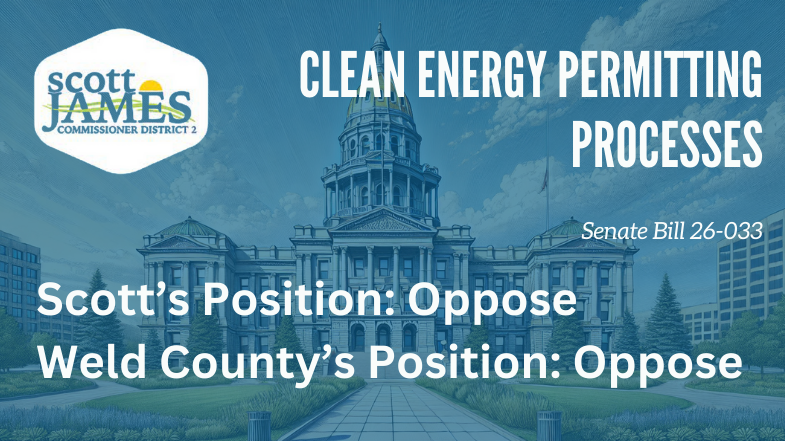
Position: Oppose
Local land use is a local responsibility. If a community wants a project, it should have the clear authority to say yes, no, or not like that, through its own public process.
This bill builds a new state office and a state-directed workflow around projects that are often permitted and managed locally. “Coordination” can sound harmless. In government, it also has a way of growing teeth.
Why I Am Taking This Position
SB26-033 says it does not preempt local land use authority. But it still creates a state office that becomes the hub: a single point of contact, meetings convened by the state, state-prepared schedules, state-managed dashboards, and state-developed model community benefit agreement terms. That is not nothing. That is bureaucratic gravity.
The practical concern is gatekeeping. Starting July 1, 2027, a state permitting authority may deem an application incomplete until a community engagement plan is submitted. That gives the state leverage over a project timeline and over local planning, even when local governments are doing the work on the ground.
The community benefit agreement language is another red flag. The bill says a permit cannot be denied solely because an agreement is not executed. But it also allows a permitting authority to consider the lack of an executed agreement to the extent the authority is otherwise authorized by law to consider community impacts and mitigation. That turns “process” into a bargaining chip and invites delays and politicized permitting.
Transparency matters, but the required public dashboard can also become a running scoreboard that fuels pressure campaigns outside the local process. Communities already have public hearings and public records. We do not need a state-run portal to referee decisions that should stay closest to the people.
Safety, emergency preparedness, and grid reliability are serious issues. We should address them directly, without building a new state office and a new web of state process requirements that can crowd out local control.
Call to Action – What You Should Do!
Contact your state senator and state representative and ask them to oppose SB26-033 as written.
Ask for a better approach that supports safety and reliability without creating a new state coordination office or adding state process leverage that can delay or influence local land use decisions.
Read the bill: Read the bill
