

Bill Summary
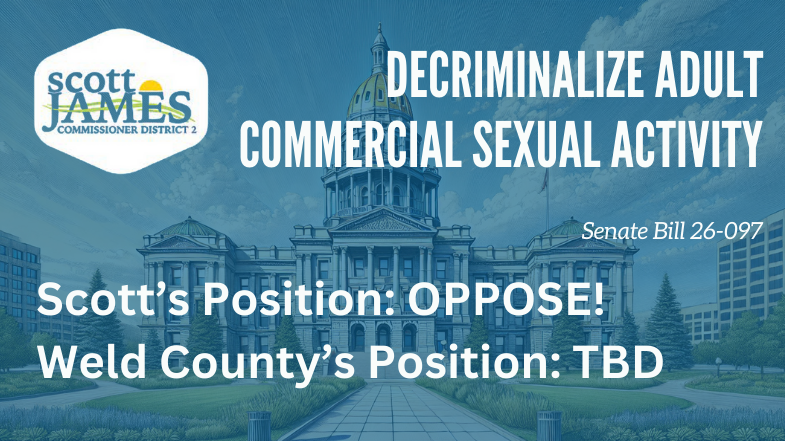
SB26-097 would decriminalize commercial sexual activity among consenting adults statewide, effective July 1, 2026. It also declares this issue a matter of statewide concern and expressly preempts counties and municipalities, including home rule jurisdictions, from criminalizing that activity.
- Repeals state criminal offenses including prostitution, soliciting for prostitution, keeping a place of prostitution, patronizing a prostitute, and “prostitute making display.”
- Repeals pandering when it involves knowingly arranging or offering to arrange a situation that permits a person to practice prostitution, while maintaining felony pandering that involves menacing or criminal intimidation (with terminology changes to “commercial sexual activity”).
- Maintains the felony crime of pimping, while changing terminology from “prostitution” to “commercial sexual activity.”
- Makes conforming changes across multiple statutes, including trafficking-related reporting and immunity language, public nuisance provisions, P.O.S.T. certification references, and rules affecting escort bureaus and massage facilities.
- Eliminates a court program for persons charged with certain prostitution-related offenses.
Position: Oppose
This bill is not limited government. It is statewide social policy backed by statewide preemption.
If the state wants to debate criminal penalties in this area, that debate should be honest and thorough. But the bill goes further by telling every county and city they are powerless to set and enforce local standards.
Why I Am Taking This Position
1) It strips local control. The bill states that an adult engaging in consensual commercial sexual activity “does not violate state law or an ordinance,” and it expressly preempts local governments from criminalizing it. That is the state overruling local voters and local elected officials on an issue that lands first in neighborhoods.
2) It picks a preemption fight on purpose. The bill declares decriminalization a “matter of statewide concern.” Words on paper do not change the real-world impacts in specific communities. When the state preempts local authority, counties and cities lose the ability to respond to what residents are actually experiencing.
3) Local communities carry the consequences. Calls for service, nuisance locations, impacts near schools and parks, and pressure on already stretched public safety and human services are local problems. This bill removes local criminal tools and replaces them with a one-size-fits-all rule from the Capitol.
4) The bill’s theory does not guarantee workable enforcement tools. The bill keeps pimping and some coercive pandering, and it argues that decriminalization lets law enforcement focus on force, fraud, or coercion. Real life is not that clean. Repealing offenses like “keeping a place of prostitution” raises practical questions about what tools remain to address problem properties early, especially once local criminal authority is preempted.
Colorado can be serious about combating trafficking and protecting victims without forcing every county and municipality into the same statewide policy and tying local hands in the process. Local control still matters, or it does not.
Call to Action – What You Should Do!
Contact your state senator and state representative and tell them to vote NO on SB26-097.
Ask them to reject statewide preemption and protect local authority to respond to neighborhood impacts.
